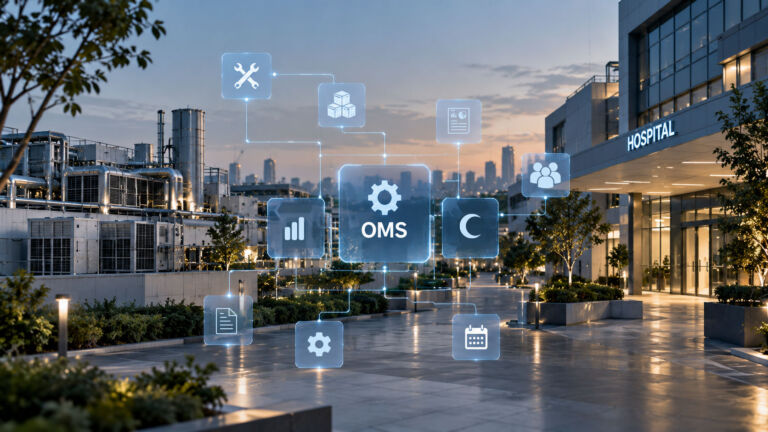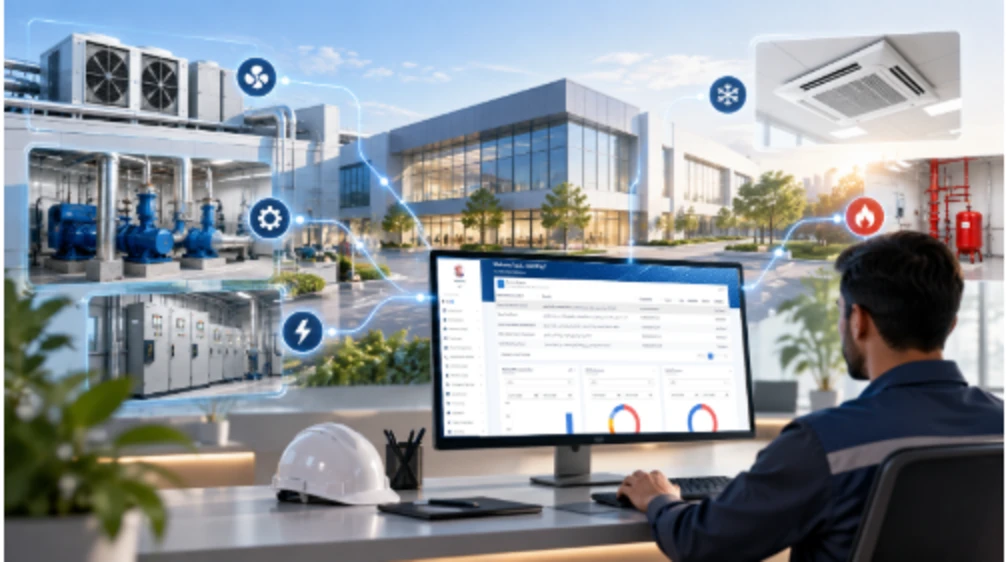
Every organization depends on physical assets to keep its operations running. These assets may be air-conditioning systems in a commercial facility, production equipment in an industrial plant, medical equipment in a hospital, or hundreds of different assets distributed across multiple sites.
The challenge is not simply maintaining those assets. The real challenge is knowing what needs attention, who is responsible, what has already been done, how much it costs, and whether operations are meeting the required performance level.
This is where an Operations & Maintenance Management System (OMS) becomes important.
An OMS is a digital platform designed to organize the information, processes, and activities involved in operating and maintaining facilities and assets. Instead of relying on disconnected spreadsheets, phone calls, paper forms, emails, or messaging applications, organizations can manage maintenance activity through one structured system.
For organizations managing multiple facilities, contracts, assets, technicians, and service providers, this creates something especially valuable: one reliable source of operational information.
What Does an OMS System Actually Do?
An OMS connects the complete maintenance journey.
A reported issue can become a service request, be classified according to its priority, assigned to the appropriate team, converted into a work order, monitored during execution, documented, approved, and eventually closed.
At the same time, the system keeps that activity connected to the asset itself.
This means organizations can build a continuously growing history showing when an asset was maintained, what failures occurred, which technician worked on it, which spare parts were consumed, how long the work took, and what documentation supported the completed job.
Steady OMS, for example, supports electronic service requests and work orders from logging and classification through assignment, execution, monitoring, approval, closure, and audit documentation.
4 Core Areas of an Operations & Maintenance Management System
A modern OMS brings several operational functions together rather than treating maintenance as an isolated activity.
- Asset Management: Creates a structured record for equipment and assets, including location, classification, condition, maintenance history, failure history, documents, and identification such as QR Codes.
- Work Order Management: Tracks maintenance work from the initial request through prioritization, assignment, execution, approval, documentation, and closure.
- Preventive Maintenance: Schedules recurring inspections and maintenance activities before failures happen, including automatic work-order generation and asset-specific checklists.
- Performance Monitoring: Converts operational activity into measurable KPIs and dashboards covering areas such as response time, completion time, preventive-maintenance performance, repeat failures, asset availability, and service quality.
From Reactive Maintenance to Structured Operations
Without an integrated system, maintenance teams can easily become reactive.
A fault happens. Someone makes a phone call. A technician is contacted. Information is exchanged through messages. Work is completed, but part of the history may never be properly documented.
That approach may work when an organization has only a few assets. It becomes increasingly difficult when there are hundreds or thousands of assets, several locations, multiple service providers, contractual response times, and financial obligations.
An OMS creates a traceable digital workflow.
Instead of simply asking, “Was the problem fixed?”, managers can ask better questions:
- How long did the response take?
- Was the required maintenance completed on time?
- Is the same asset failing repeatedly?
- What is causing the downtime?
- Are spare parts available?
- Is the contractor meeting the required service level?
That shift transforms maintenance information into operational intelligence.
Good maintenance is not only about completing the work. It is about creating reliable information from every completed activity so the next decision can be better than the last.
Why Asset History Matters
One of the most important advantages of an OMS is the creation of a complete asset record.
Every inspection, work order, failure, repair, checklist, document, and maintenance visit contributes additional information about the asset.
Over time, this history helps operations teams move beyond guesswork.
For example, if an asset begins experiencing repeated failures, managers can review its maintenance history, downtime, repair frequency, and associated costs before deciding whether continued repair remains reasonable or whether replacement should be evaluated.
Steady OMS supports a unified electronic asset register containing asset identification, location, classification, condition, maintenance and failure history, documents, and QR Code identification.
Turning Maintenance Data Into Decisions
Collecting data has little value if decision-makers cannot understand it.
That is why dashboards and performance indicators are an important part of an OMS.
Metrics such as MTBF (Mean Time Between Failures) can help teams understand equipment reliability, while MTTR (Mean Time To Repair) can show how efficiently failed assets are returned to service.
Other indicators may measure preventive-maintenance completion, response times, recurring failures, downtime, service quality, costs, inventory performance, or contractor performance.
Steady OMS provides real-time dashboards and operational, administrative, and financial reporting designed to support analysis, identify exceptions, and improve decision-making.
OMS Goes Beyond Maintenance
An OMS should not be viewed simply as a digital repair log.
Modern operations involve connections between maintenance, assets, contracts, inventory, procurement, projects, quality, risks, safety, energy consumption, and financial processes.
For example, a completed work order may consume a spare part from inventory. That spare part may reach its reorder level and create a procurement requirement. The work order may also affect a contractual KPI or contribute to a monthly payment certificate.
When these processes exist in isolated systems, understanding the complete operational picture becomes difficult.
When they are connected, managers can see how individual maintenance activities influence wider operational and financial performance.
Steady’s scope also includes procurement, warehouse and inventory management, service providers and subcontractors, risk and safety indicators, and electronic archives. Organizations that need finance, HR or other business modules can add Steady ERP on the same platform.
OMS vs. CMMS: What Is the Difference?
The terms OMS and CMMS — Computerized Maintenance Management System — overlap, but they are not always used to describe exactly the same scope.
A traditional CMMS primarily focuses on maintenance activities such as assets, maintenance schedules, work orders, and spare parts.
An OMS can extend that foundation into broader operational management, bringing areas such as contracts, projects, service-provider evaluation, budgets, benchmarking, and multi-site operations into the same environment.
Steady currently describes its OMS as combining maintenance-management capabilities with this wider operational scope.
Building Smarter Operations with Steady OMS
For organizations in Saudi Arabia managing facilities, equipment, maintenance teams, and service providers, the goal of digital transformation should not simply be replacing paper with screens.
The goal is to create a reliable operational system of record.
Steady OMS brings asset information, service requests, work orders, preventive maintenance, spare parts, operational performance, and related management processes into one environment. Its current platform also provides Arabic and English support and mobile access for field teams.
When every maintenance activity contributes to a structured operational history, organizations gain something more important than digital records: they gain the information needed to make better decisions about assets, people, costs, performance, and service continuity.
Frequently Asked Questions
What does OMS stand for?
OMS stands for Operations & Maintenance Management System. It is software used to manage assets, maintenance activities, service requests, work orders, preventive maintenance, spare parts, and operational performance.
What is the main purpose of an OMS?
The main purpose is to centralize operations and maintenance information so organizations can plan, execute, document, monitor, and analyze maintenance activities instead of managing them through disconnected files and communication channels.
Is an OMS the same as a CMMS?
They overlap significantly. A CMMS primarily focuses on maintenance, assets, work orders, and spare parts. An OMS can extend those capabilities into wider operational areas such as contracts, projects, service providers, budgets, and multi-site performance.
Who can use an OMS system?
OMS platforms can support organizations that operate physical facilities or equipment, including facility management companies, industrial organizations, hospitals and healthcare facilities, and commercial enterprises.
Does Steady OMS support preventive maintenance?
Yes. Steady OMS supports preventive and scheduled maintenance plans, automatic work-order generation, asset-specific checklists, and documentation of inspection and maintenance activities.
Can an OMS help measure maintenance performance?
Yes. An OMS can monitor KPIs such as response and completion times, preventive-maintenance performance, repeated failures, asset availability, downtime, MTBF, MTTR, costs, and other operational indicators.