


Steady OMS | An integrated CAFM/CMMS system for healthcare facilities and assets that connects field work with real-time KPIs and management decisions.
In the Hajj season, operational decisions cannot wait. Health leaders need a clear and continuous view of facility readiness, the availability of assets and healthcare services, the progress of maintenance work, and how well contractors meet service levels.
During Hajj 2026, the Makkah Health Cluster used Steady OMS to manage operations and maintenance and to monitor performance, through a central digital environment that connects assets, work orders and maintenance activities with operational KPIs.
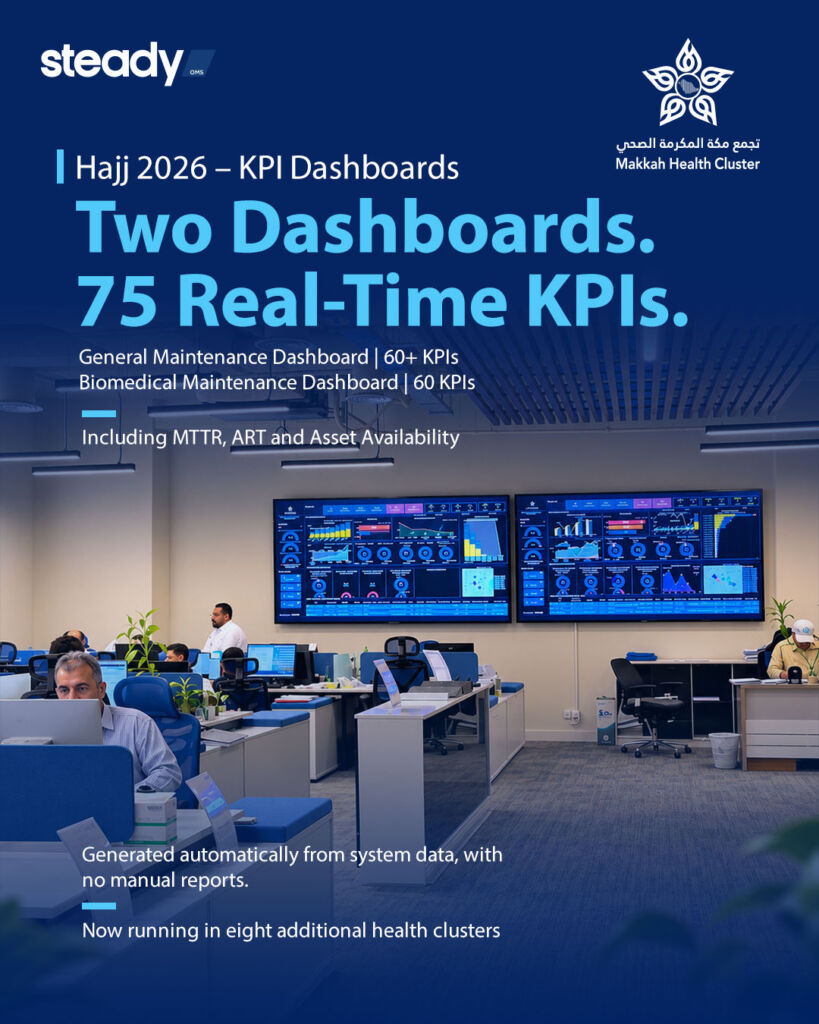
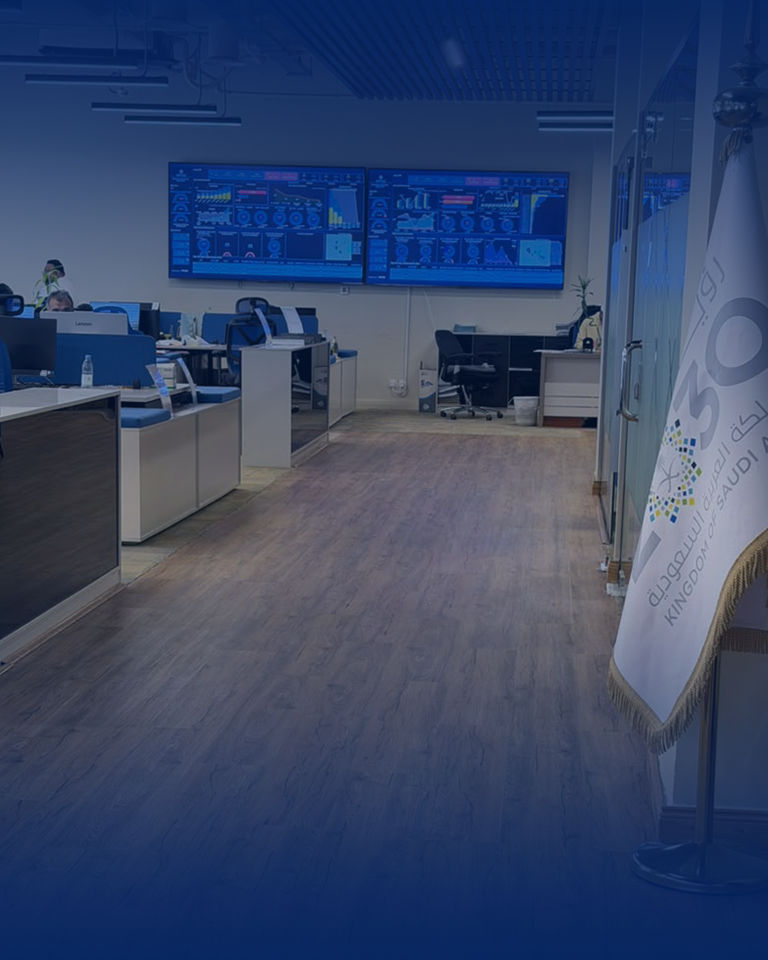
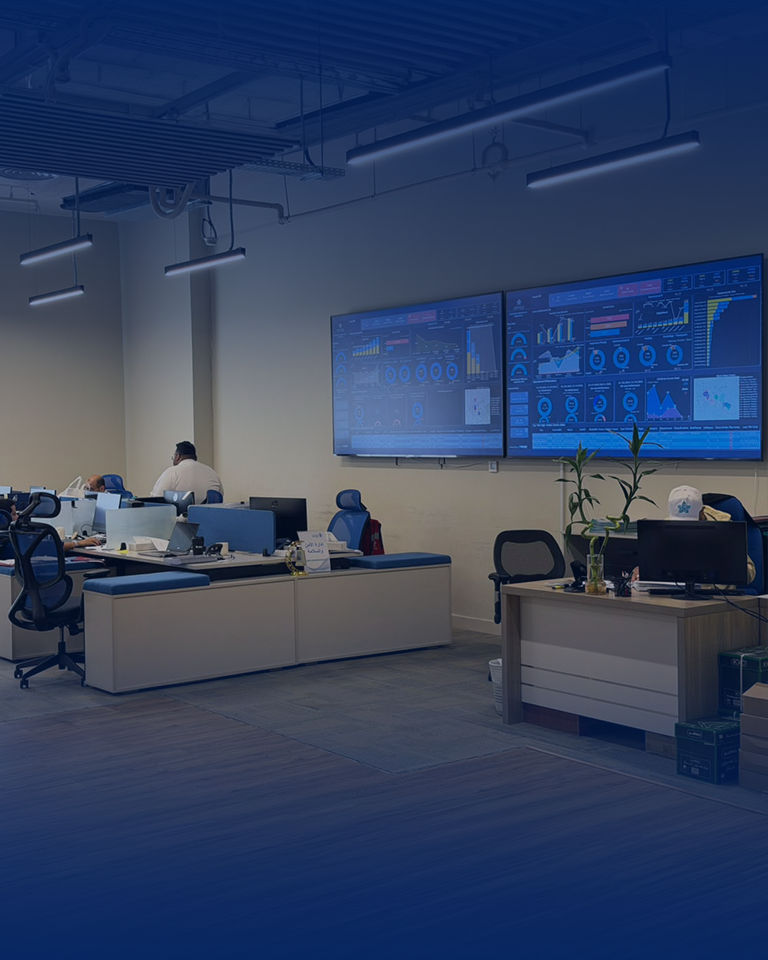
The platform provided two real-time dashboards designed specifically for this experience: the General Maintenance Dashboard, with more than 60 KPIs, and the Biomedical Maintenance Dashboard, with 60 KPIs, covering 75 KPIs in total across the system. The KPIs are generated automatically from the operational data recorded in the system, to support monitoring of facility readiness and of asset and healthcare-service availability, and to help leaders identify priorities and where to intervene.
After the model was applied in the Makkah Health Cluster, the same operational KPI dashboards were extended to eight additional health clusters.
This experience shows how an organization can move from managing day-to-day work to a unified operating model in which actual data is the basis for monitoring, performance measurement and decision support.
Project overview
| Item | Details |
|---|---|
| Solution | Steady OMS – CAFM/CMMS system |
| Industry | Healthcare and healthcare facility management |
| Organization | Makkah Health Cluster |
| Reference implementation | Hajj 2026 |
| Operational data | Steady OMS statistics for 2026 |
| KPI dashboards | Two dashboards designed for Hajj: General Maintenance (60+ KPIs) and Biomedical Maintenance (60 KPIs), 75 KPIs in total |
| Implementation | Data entered through Excel sheets; all users trained in about three months |
| Expansion | The same KPI dashboards extended to eight additional health clusters |
The operating environment in numbers
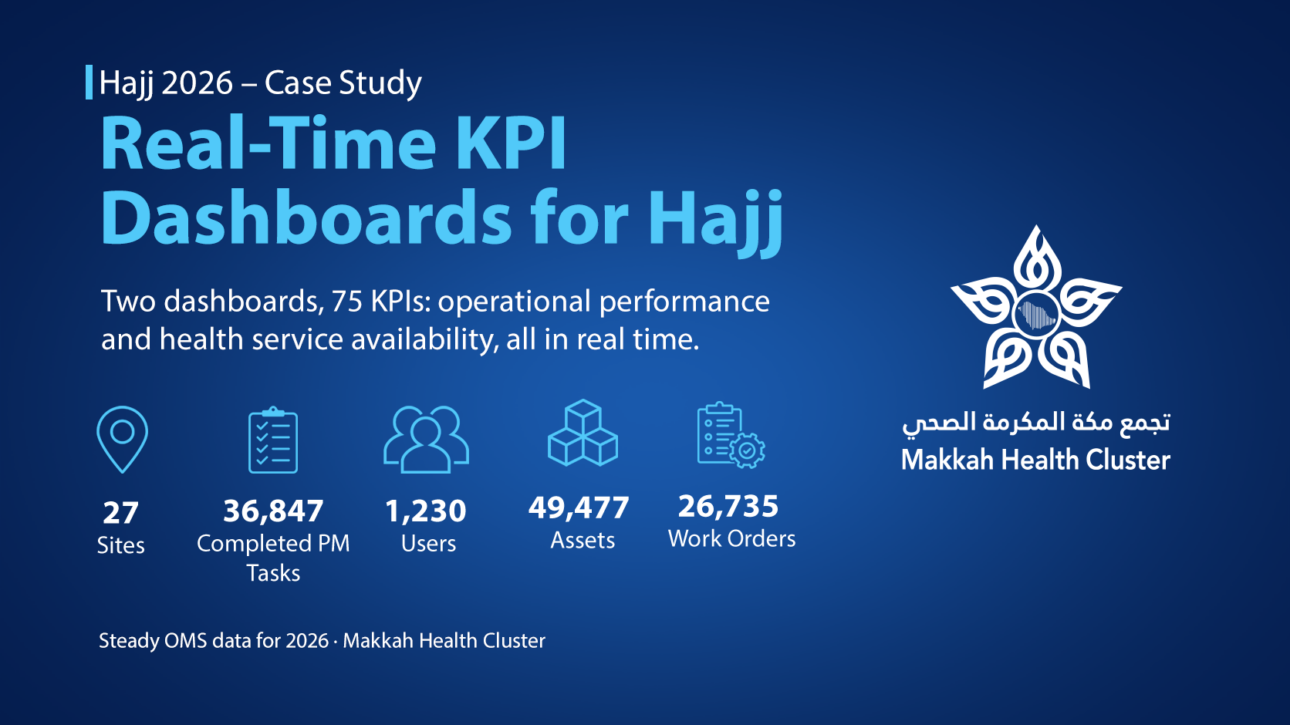
The following statistics give a picture of the operating environment the KPI dashboards were designed to monitor within the Makkah Health Cluster.
- 27 healthcare sites connected to the KPI dashboards: 20 medical maintenance sites and 7 general maintenance sites.
- 1,230 users: 316 main users and 914 sub-users; 910 in medical maintenance and 320 in general maintenance.
- 49,477 assets and devices: 31,086 in medical maintenance and 18,391 in general maintenance.
- 26,735 work orders and repair requests: 5,152 for medical maintenance and 21,583 for general maintenance.
- 36,847 completed preventive maintenance tasks: 28,652 for medical maintenance and 8,195 for general maintenance.
- 2 dashboards designed specifically for the Hajj experience: General Maintenance, with more than 60 KPIs, and Biomedical Maintenance, with 60 KPIs, covering 75 KPIs in total.
- 8 additional health clusters using the same operational KPI dashboards.
These figures represent the operational context the KPI dashboards are built on. They are not presented as a measure of the results of implementing the system.
Data note: The site, user, asset, work order and preventive maintenance figures are Steady OMS data for 2026, as provided in the Makkah Health Cluster table. They are not assumed to have been carried out only during the days of the Hajj season.
Sites connected to the KPI dashboards in Makkah
Makkah Health Cluster manages operations and maintenance across 27 healthcare sites through Steady OMS, connecting assets, work orders, and maintenance activities to real-time KPI dashboards for centralized performance monitoring and data-driven decision-making.
Medical maintenance sites
- Al-Nour Specialist Hospital, Makkah
- Maternity, Women and Children Hospital, Makkah
- Heraa General Hospital, Makkah
- King Abdulaziz Hospital, Makkah
- King Faisal Hospital, Makkah
- Ajyad Emergency Hospital, Makkah
- Al-Haram Emergency Hospital, Makkah
- Khulais Hospital, Makkah
- Regional Laboratory, Makkah
- Mobile Team, Makkah
- Al-Mashaer Hospitals – Mina, New Street
- Al-Mashaer Hospitals – Mina Al-Wadi
- Al-Mashaer Hospitals – Mina Al-Jisr
- Al-Mashaer Hospitals – Mina Emergency
- Al-Mashaer Hospitals – Mina Jamarat
- Al-Mashaer Hospitals – Third Arafat General Hospital
- Al-Mashaer Hospitals – East Arafat
- Al-Mashaer Hospitals – Jabal Al-Rahma
- Al-Mashaer Hospitals – Namirah
- Al-Mashaer Centers (A-M)
General maintenance sites
- Al-Nour Specialist Hospital, Makkah
- Makkah General Hospital
- King Faisal Hospital, Makkah
- Ajyad General Hospital, Makkah
- Al-Haram Hospital, Makkah
- Khulais General Hospital, Makkah
- Mobile Team, Makkah
The challenge: managing healthcare readiness in a high-demand environment
The Hajj season demands a high level of coordination and operational readiness, especially in healthcare facilities that need continuous monitoring of assets, maintenance work, services and contractors.
The challenge is not limited to logging reports or carrying out repairs. It lies in turning daily operations into reliable information that helps leaders understand the operational situation and make the right decisions. The need was for a connected view that answers a set of essential questions:
- What is the readiness level of the healthcare facilities?
- What is the condition and availability of assets and devices?
- Which work is currently in progress?
- Which work orders need intervention?
- What is the status of preventive maintenance work?
- How are medical and general maintenance progressing?
- How well are contractors meeting service level agreements (SLAs)?
- Which KPIs need management follow-up?
- How can a KPI be traced back to the actual source of a problem?
Answering these questions requires connecting field data with assets, work orders, maintenance, contractors and KPIs in one environment.
The challenge was not only collecting data, but making it measurable, analyzable and traceable, and turning it into an operational view that helps set priorities for intervention.
The solution: Steady OMS as a central CAFM/CMMS system connecting data to decisions
The Makkah Health Cluster used Steady OMS to connect operations, maintenance, assets and work orders in a central system that supports performance monitoring through real-time KPI dashboards. In this healthcare facility management setting, Steady OMS serves as the cluster's CAFM/CMMS system.
The platform records operational activities as they are carried out, so the actual data recorded in the system becomes the source for creating KPIs. Instead of relying on separate reports prepared after the work is finished, the platform generates the indicators automatically from operational data.
The key difference is that a KPI is never separated from the operational activity that produced it.
Through Steady OMS, users can move from an overall view of performance to the details linked to work orders and contractors. The platform provided two real-time dashboards, covering 75 KPIs, to monitor:
- Maintenance performance.
- Healthcare facility readiness.
- Availability of assets and devices.
- Availability of healthcare services.
- Facility operations.
- Contractor compliance with service levels.
- Operational work linked to KPIs.
Implementation: Data was entered through Excel sheets, and training all users and distributing their accounts took about three months.
How operational data becomes a management decision
Steady OMS connects each stage of the operational chain, so the data recorded at one stage feeds the next.
- Assets: medical and general assets and devices.
- Work orders: work orders and repair requests.
- Maintenance: medical, general and preventive maintenance.
- Operational data: activities recorded as the work is carried out.
- KPIs: dashboards generated automatically from that data.
- Management decisions: priorities and points of intervention.
How Steady OMS supported operations during Hajj 2026
1. Two KPI dashboards designed specifically for Hajj
The platform provided two real-time dashboards designed specifically for the Hajj season: the General Maintenance Dashboard, with more than 60 KPIs, and the Biomedical Maintenance Dashboard, with 60 KPIs, covering 75 KPIs in total across the system. Together they give a central view of operations and maintenance performance within the Makkah Health Cluster. They cover maintenance performance, asset availability, healthcare service delivery and facility operations, with indicators such as Mean Time to Repair (MTTR), Average Response Time (ART) and Asset Availability.
The KPIs are generated automatically from the actual data recorded in the system, with no need to re-enter data by hand to prepare them. This model provides operational information tied to actual work, instead of relying on indicators whose sources cannot be traced.
2. Unified visibility of healthcare facility readiness
The KPI dashboards helped provide a real-time picture of healthcare facility readiness and of the status of the operations linked to it. They let leaders follow performance across facilities and move from the overall level to the details of the work behind each indicator.
This view helps identify the areas that need intervention, especially during seasons that require continuous operational monitoring.
3. Asset and maintenance data as the source of the KPIs
The KPI dashboards are built on the data recorded in the system: medical and general assets and devices, work orders and repair requests, and medical, general and preventive maintenance tasks. Every asset, work order and maintenance task becomes part of the data the indicators are generated from.
The dashboards therefore do not show numbers detached from the work. They let leaders move from an overall indicator to the actual work behind it.
4. KPI drill-down to work orders and contractors
One of the most important capabilities this case study highlights is the ability to trace KPIs down to the operational data linked to them. This helps management move from noticing a change in a KPI to understanding the actual work that contributed to it, so the KPI dashboards become a tool for monitoring and analysis, not just a way to display numbers. The traceability path is shown below.
5. Contractor SLA performance monitoring
The KPI dashboards included monitoring of contractor compliance with agreed service levels (Service Level Agreements, SLAs). The platform links KPIs to work orders and to the contractors associated with them, which gives a clearer view of operational performance.
This link helps identify the areas that call for a review of contractor performance or for follow-up on work related to service levels.
Performance traceability: from KPI to work order and contractor
In Steady OMS, every KPI can be traced back to the operational records that produced it. The follow-up path runs from the health cluster to the contractor associated with each work order:
Health cluster → KPI dashboard → Operational KPI → Work order → Associated contractor
From Hajj 2026 to nine health clusters
The use of the KPI dashboards did not stop at the Hajj 2026 experience in the Makkah Health Cluster. After the model was used during the season, the same operational KPI dashboards were extended to eight additional health clusters working on Steady OMS.
The eight health clusters the KPI dashboards were extended to are:
- Riyadh Second Health Cluster
- Riyadh Third Health Cluster
- Jeddah First Health Cluster
- Jeddah Second Health Cluster
- Hail Health Cluster
- Aseer Health Cluster
- Madinah Health Cluster
- Taif Health Cluster
This expansion shows that a performance monitoring model based on operational data can be applied in several healthcare environments. The model rests on three main elements:
- Actual data from daily operations: KPIs are generated from the operational data recorded in the system, so each indicator stays linked to its source.
- Centralized performance visibility: The KPI dashboards bring maintenance, asset and service availability, and facility operations information into one monitoring environment.
- Traceable KPIs: The platform lets users move from overall indicators to the work orders and contractors linked to them.
The experience is therefore a model for using operational KPIs at a scope beyond a single project or season.
Scope note: the expansion means applying the KPI dashboards in eight additional health clusters. It does not necessarily mean that every module and function of the platform was rolled out in each cluster.
The role of the KPI dashboards in monitoring and decisions
- Decision support: The dashboards let leaders move from the overall picture of performance to the operational details that help set priorities and points of intervention.
- Stronger readiness monitoring: The KPIs gave a real-time view of facility readiness and of asset and healthcare-service availability.
- Contractor monitoring: Linking KPIs to work orders and contractors gave clearer information on compliance with service levels (SLAs).
- Automated KPIs: The dashboards are generated from actual data recorded in the system, without entering data again by hand to produce the indicators.
- One monitoring platform: The dashboards bring operations and maintenance information into one environment instead of several report sources.
- Scalability: The same KPI dashboards were extended to eight additional health clusters, showing that the model can be applied on a wider scale.
Result: from managing daily work to data-driven decisions
The Makkah Health Cluster experience during Hajj 2026 showed the value of KPI dashboards designed specifically to support decisions, when they are directly connected to operations and maintenance.
During the Hajj season, the two real-time dashboards, covering 75 KPIs, provided a central view of maintenance performance, asset and service availability and facility operations, with KPIs traceable to the work orders and contractors linked to them. After the model was applied in the Makkah Health Cluster, the same KPI dashboards were extended to eight additional health clusters.
The experience shows how an integrated CAFM/CMMS system can connect assets → work orders → maintenance → operational data → KPIs → management decisions in one digital environment.
“During Hajj, decisions can't wait. The KPI dashboards gave us a real-time picture of our facilities' readiness and our contractors' compliance with service levels, so we knew where to intervene, and when.”
Steady OMS: from field work to KPIs and executive decisions. An integrated CAFM/CMMS system that helps healthcare organizations connect their daily work with measurable KPIs. Clearer operations. Measurable performance. Better visibility of readiness. Data-driven decisions.